Electronics · Audio, wearables, smart devices & accessories

The best dehumidifiers of 2026

All four dehumidifiers here are in the EPA's ENERGY STAR register, and the register publishes the capacity each one removed in the federal test. Three of them measured within 1% of the number on their listing. The fourth is sold as a 150 pint machine and was measured at 49.47.

We read the EPA's own ENERGY STAR export for certified dehumidifiers, 535 rows covering 511 portable models, and matched each product to its row by the model number in its Amazon specification table. Every figure we attribute to the register is the EPA's, and where we quote a number off a listing we say whose it is. We also read each listing's title, its bullets and its gallery photographs, because the three do not always agree.

Last updated
August 1, 2026
How we rank: the specs each maker publishes, read across the listing's own surfaces, and the third-party register where the category has one.
§ 01 · Top 4 Rankings

Our top 4 picks for dehumidifiers

As an Amazon Associate I earn from qualifying purchases.

#1
EDITOR'S CHOICE
Midea Cube 50 Pint Dehumidifier
Zoom
Midea

Midea Cube 50 Pint Dehumidifier

9.3/10JellyReviews Score

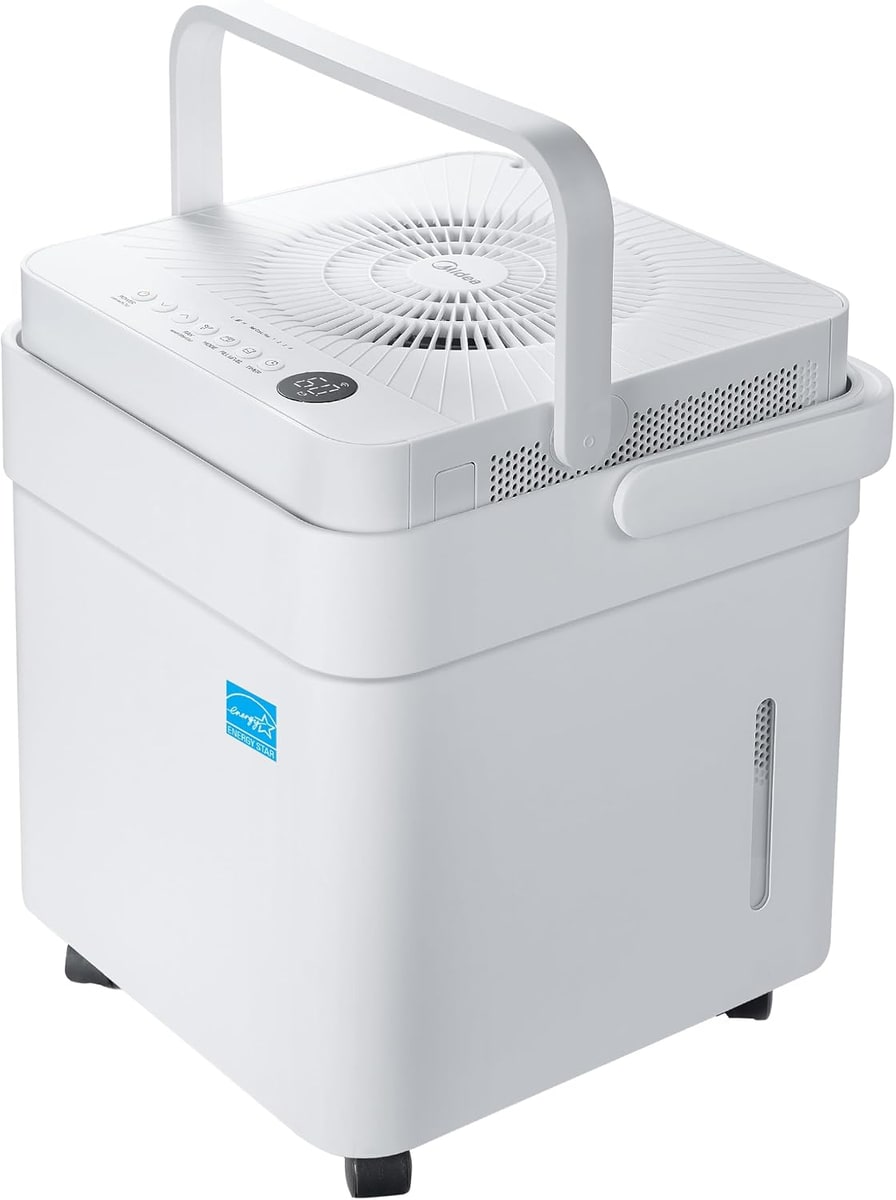
Buy this one if you want the number on the box to be the number the government measured. The EPA lists MAD50S1QWT-A at 49.67 pints per day against a listing that says 50, and at 515 kWh a year. The 4.2 gallon tank beats both tanks anyone else here publishes, which matters because this model has no pump and you will be carrying it. Midea footnotes that tank as "3X more water capacity" compared to its own 2019 model of similar capacity, a qualifier that appears in the photograph and not in the bullet above it.

Pros
The EPA register lists model MAD50S1QWT-A at 49.67 pints per day and 515 kWh a year, so the 50 pint number on the listing is the federal one
A 4.2 gallon tank, against the 2.25 gallons Hisense describes as 18 pints and the 2.11 gallons Waykar publishes
The ENERGY STAR mark photographed on the machine is the one the register records, certified 20 October 2025
Midea photographs "works with alexa" and "works with Google Home" badges in the gallery, and its bullets describe app control over Wi-Fi
Cons
No pump. Water leaves by gravity through the included drain hose, so you need a drain below the unit
The specification table gives the height as 14.96 inches, which is the nested height. Midea's own dimension photograph shows the machine standing 25.43 inches when extended
The gallery bar chart claiming "25% Saving" names its comparator only as "Other Brands"
Where to buy
Amazon
Check Price
We may earn a commission from this link.
#2
BEST WITH PUMP
Hisense 50-Pint Lift-Up Dehumidifier with Built-In Pump
Zoom
Hisense

Hisense 50-Pint Lift-Up Dehumidifier with Built-In Pump

9/10JellyReviews Score

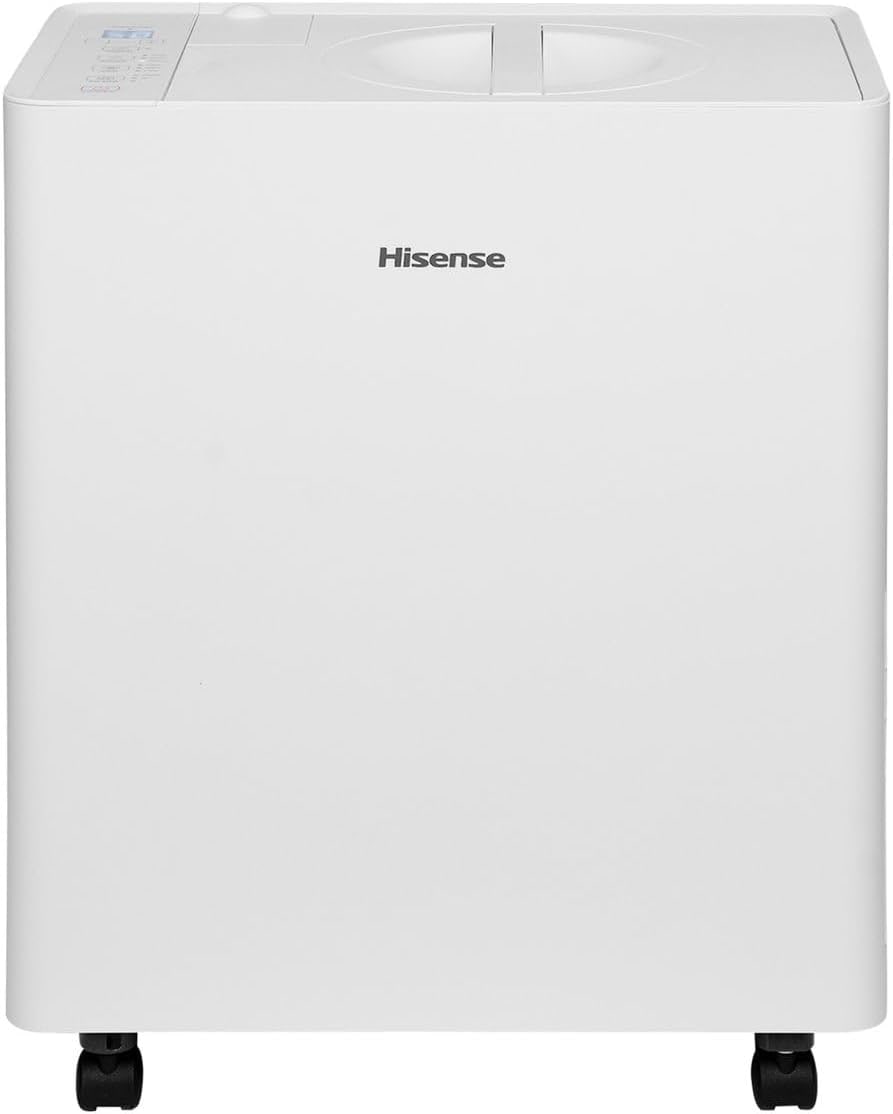
This is the pump pick. The EPA measured ALDH50KP26 at 49.89 pints per day, and among the products here that is the smallest gap between what a listing claims and what the federal test found. The pump matters more than the 0.2 of a pint: it sends water to a sink or a window rather than requiring a drain below the machine, and the tank lifts out of the top so you are not crouching to empty it. The odd part is the marketing. Hisense holds an ENERGY STAR certification and puts it in neither its title nor any of its five bullets.

Pros
The EPA register lists model ALDH50KP26 at 49.89 pints per day, closer to its 50 pint claim than the 49.67 on the Midea or the 49.66 on the Honeywell
A built-in pump and a quick-connect hose, so water can go up to a sink or out of a window instead of down to a floor drain
A top-lift 18 pint tank, which is the part of a dehumidifier you touch most often
Four casters and a washable filter, both stated in Hisense's own bullets
Cons
Hisense holds a certification it does not advertise. The words ENERGY STAR appear in neither the title nor any of its five bullets, and the machine is in the register
The listing gives no wattage and no noise figure
The EPA puts it at 526 kWh a year against 507 for the Waykar, though all four sit inside 19 kWh of each other
Where to buy
Amazon
Check Price
We may earn a commission from this link.
#3
WI-FI AND PUMP
Honeywell 50-Pint Dehumidifier with Pump, TPFIT50PWK
Zoom
Honeywell

Honeywell 50-Pint Dehumidifier with Pump, TPFIT50PWK

8.7/10JellyReviews Score

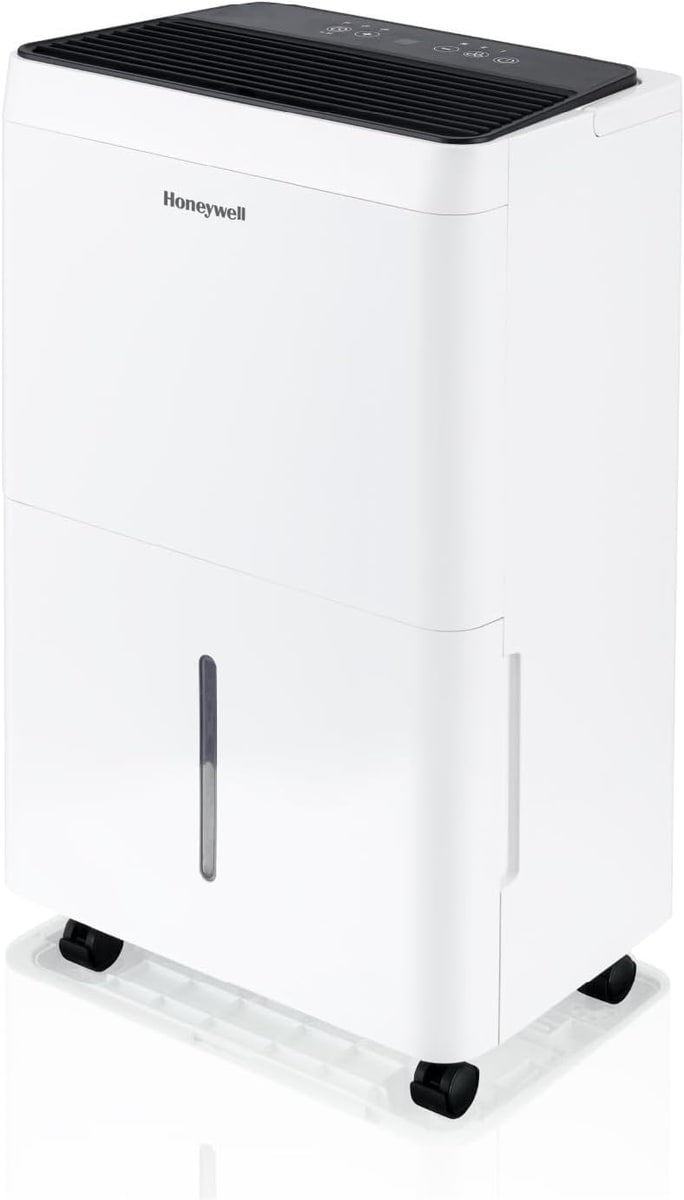
The certification is solid and the listing is nearly empty. The EPA has TPFIT50PWK at 49.66 pints per day and 516 kWh a year, certified on 6 March 2026, two months after the Hisense and over four months after the Midea. It has a pump and it has Wi-Fi: the Hisense listing states a pump and no app, the Midea states an app and no pump. What you cannot learn from the page is how big the tank is, how loud it runs, or what it draws, because Honeywell publishes one bullet and three photographs. The federal register says more about this machine than the people selling it do.

Pros
The EPA register lists model TPFIT50PWK at 49.66 pints per day and 516 kWh a year, certified 6 March 2026, the most recent of the four certifications here
Both a pump and Wi-Fi. The register marks it connected capable over Wi-Fi, and the gallery shows the Honeywell app
A stated airflow of 360 cfm in the specification table, against the 159 cfm Waykar publishes
Cons
The listing carries a single feature bullet, and it is marketing: "energy efficient and reliable, now with enhanced features". No tank size, no noise figure, no wattage
Three gallery photographs and one bullet between them. Nothing anywhere on the listing about how it drains, or how big the tank is
Honeywell claims 4,000 square feet where the Midea listing claims 4,500, on machines the EPA measured 0.01 pints apart
Where to buy
Amazon
Check Price
We may earn a commission from this link.
#4
Waykar 150 Pint Dehumidifier
Zoom
Waykar

Waykar 150 Pint Dehumidifier

7.9/10JellyReviews Score

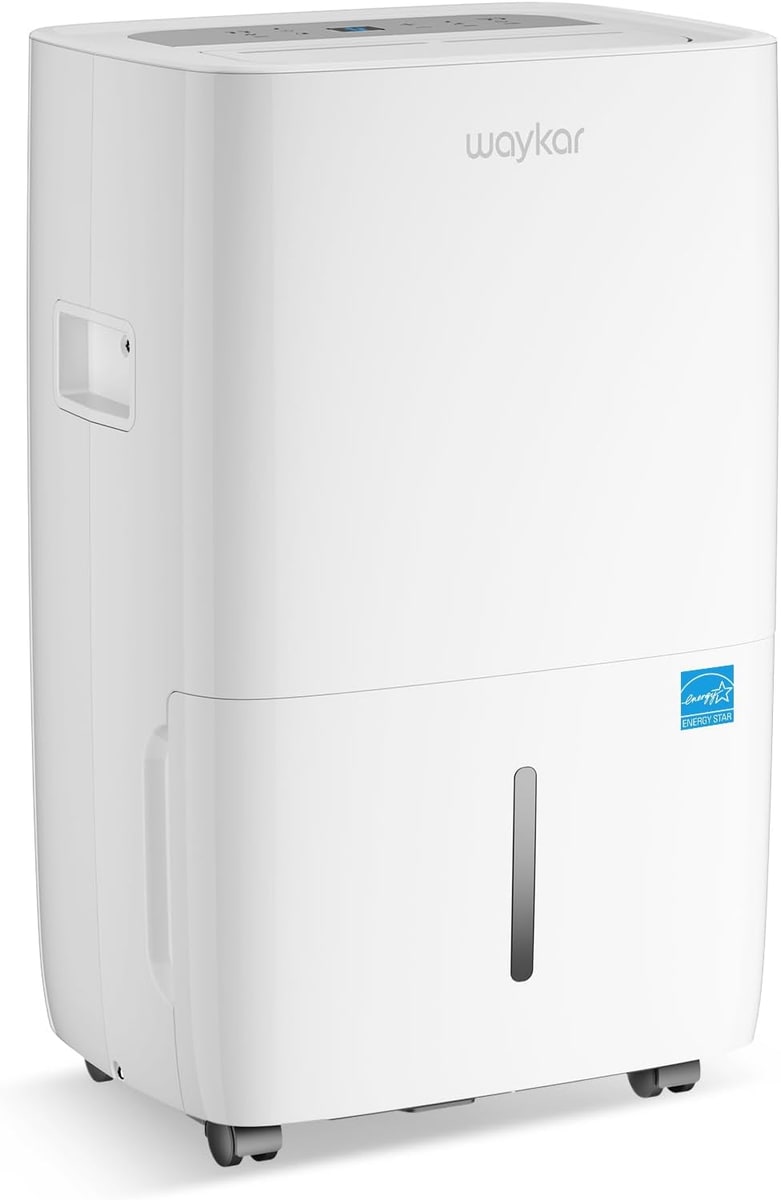
A 50 pint machine wearing a 150 pint label, and Waykar is the one telling you so. Bullet one gives the condition: 150 pints per day at 95F and 90% relative humidity. The EPA runs its test at 65F, and by that test JD026CE-150 removes 49.47 pints per day, which is within half a pint of every other product on this page. It also uses the least electricity of the four at 507 kWh a year. The problem is the picture. Waykar's own marketing panel prints the 150 and the 7,000 square feet with no condition attached, and that is the version a buyer sees first.

Pros
The EPA register lists model JD026CE-150 at 507 kWh a year, under the 515 on the Midea, the 516 on the Honeywell and the 526 on the Hisense
Waykar states the condition behind its headline number in bullet one: "up to 150 pints of moisture per day (95F, 90% RH)"
A 2.11 gallon tank, a 3.3 foot drain hose and a 24 hour timer, all stated on the listing
Waykar publishes a 1 year warranty, extendable. Neither the Hisense nor the Honeywell bullets mention a term at all
Cons
The EPA measured this model at 49.47 pints per day. The listing sells it as 150 pints, because the two numbers come from different test conditions
Waykar attaches no test condition to the "7,000 Sq. Ft" figure anywhere on the listing, so there is no way to tell which rule it was measured under
The marketing photograph prints "150-Pint Capacity | 7000 Sq. Ft Space" with no test condition anywhere on it, though the bullet underneath states one
It publishes 750 watts of draw against Midea's 490, and it is the only one of the four whose headline capacity is not the federal figure
Where to buy
Amazon
Check Price
We may earn a commission from this link.
§ 02 · Side-by-side comparison

Compare all 4 at a glance

RankProductBrandScoreBest for
#1Midea Cube 50 Pint DehumidifierMidea9.3EDITOR'S CHOICE
#2Hisense 50-Pint Lift-Up Dehumidifier with Built-In PumpHisense9BEST WITH PUMP
#3Honeywell 50-Pint Dehumidifier with Pump, TPFIT50PWKHoneywell8.7WI-FI AND PUMP
#4Waykar 150 Pint DehumidifierWaykar7.9-
§ 03 · Buying guide

How to choose the right dehumidifier

01The pint number depends on which test it came from

The Department of Energy changed how dehumidifiers are rated in 2019. The old test ran at 80F and the current one runs at 65F, so the same machine produces a lower number under the current rule. Manufacturers can also quote a saturation figure taken at around 95F and 90% relative humidity, which is higher again.

You can watch this happen inside a single listing. Waykar sells JD026CE-150 as a 150 pint machine and states in its first bullet that the figure is measured at 95F and 90% RH. The EPA measured the same model at 49.47 pints per day. A BLACK+DECKER 50 pint listing prints both standards in one sentence: "up to 4500 sq. ft. 2012 DOE / 650 sq. ft. 2019 DOE standard". That is the same machine covering seven times more floor on the older rule.

The federal register only publishes the current figure. If you want one number that means the same thing across every brand, that is the number to use.

02What ENERGY STAR certification does and does not tell you

The EPA publishes every certified dehumidifier in a downloadable file: 535 models, 511 of them portable. Each row carries the measured capacity in pints per day, the efficiency as an Integrated Energy Factor in liters per kilowatt hour, and the annual energy in kilowatt hours. Every certified brand reports into that file in the same units, which is not true of the capacity and coverage numbers on the listings themselves.

Certification is a floor, not a ranking. Of the 511 portable models, 199 sit at exactly 2.01 L/kWh, so that value is a cluster rather than a differentiator. All four machines on this page sit at 2.01, and their annual energy runs from 507 to 526 kWh, a spread of 19 kWh. On efficiency alone, these products are the same machine.

There is a stricter tier called ENERGY STAR Most Efficient 2025, and it is worth knowing where it lives. Of the 107 portable models that hold it, 59 are under 20 pints a day and 41 are between 20 and 29. Five are in the 50 pint class, and they are branded Vellgoo, Waykar, MegaLight and ZAFRO. Waykar holds two of them, CTH150D and CTH150PD at 2.2 L/kWh and 471 kWh a year, and neither is the machine it sells on Amazon as a 150 pint dehumidifier.

03Match the model number, not the brand

A brand being in the register does not put the machine in your basket in the register. Frigidaire has six certified models and every one of them starts FHDD or FHDP. The FFAD5033W1 that this page used to recommend is in none of them. Frigidaire's certified 50 pint model is FHDD5033Y1, listed at 49.95 pints per day.

Certification is pinned to a model number, and Amazon titles rarely carry one. The number is in the specification table under Model Number, and that is the field that joins a listing to the register. One Waykar family makes the point on its own: CTH150A, CTH150B, CTH150PA and CTH150PB are certified at 2.01 L/kWh, while CTH150D and CTH150PD are certified at 2.2 and hold Most Efficient. One letter apart, and nothing in a product title tells you which one is in the box.

The register also shows when one machine is sold under several names. One row lists its brand as "waykar, KESNOS, YAUFEY, Fehom", which is four Amazon brands sharing a single certification and a single model number.

§ 04 · FAQ

Questions about dehumidifiers

The EPA says to keep indoor humidity "below 60 percent (ideally between 30 and 50 percent) relative humidity", in its Brief Guide to Mold, Moisture and Your Home. So 60% is the line that matters and 30% to 50% is the target, which is worth knowing before you set a dehumidifier to run at 35% and pay for it. Two of the four publish the range they will hold: Waykar states 30% to 80% and Midea states 35% to 85%, which are the same width set five points apart, so of those two only the Waykar reaches the 30% the EPA names. The Hisense and Honeywell listings do not say.

A gravity hose only works if there is a drain lower than the machine. If your floor drain is across the room, or you want the water to reach a sink or a window, you need a pump. Two of the four here have one, the Hisense and the Honeywell. The Hisense includes a quick-connect hose, and a BLACK+DECKER 50 pint listing describes a 16 foot pump hose, which gives you a sense of the reach involved.

The EPA publishes an annual figure for every certified model, based on a standard duty cycle. The four machines on this page run from 507 kWh a year (Waykar JD026CE-150) to 526 kWh (Hisense ALDH50KP26). That 19 kWh spread is 3.7%, so on a page of certified 50 pint units, energy use is not a reason to pick one over another. The gap that would matter is against an uncertified machine, and an uncertified machine has no published figure to compare.

Refrigerant dehumidifiers pull moisture onto a cold coil, and when the room is cold enough that coil ices over instead. It happens most below about 65F, and a dirty filter makes it worse by cutting airflow. Clean the filter, leave clearance around the cabinet, and check whether your model has an auto defrost cycle. If a machine keeps freezing in a room that is warm enough, that is a refrigerant problem and a warranty question rather than a setting.

The verdict

The Midea Cube 50 Pint is the one to buy for most basements: the EPA measured it at 49.67 pints per day against a listing that says 50, its 4.2 gallon tank beats both tanks anyone else here publishes, and the ENERGY STAR mark in its photographs is the one in the register. If your drain is not below the machine, take the Hisense 50-Pint Lift-Up instead, which was measured at 49.89 pints and has a pump and a quick-connect hose. The Honeywell TPFIT50PWK gives you a pump and Wi-Fi together and tells you almost nothing else about itself. The Waykar is a competent 50 pint machine with a 150 pint label, and it deserves credit for printing the test condition in its bullet even though its own marketing image leaves it off.

This page contains affiliate links. We may earn a commission when you click through and make a purchase. This never affects our rankings. Read full disclosure →